
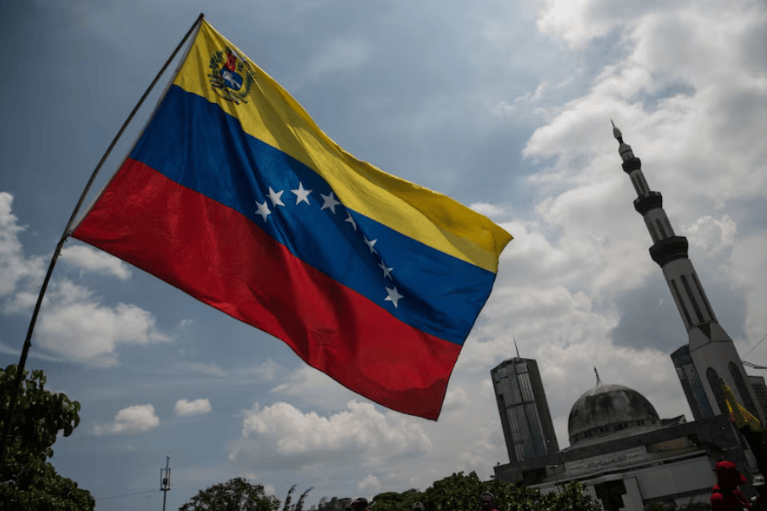
Nine months after the United States captured Nicolás Maduro, Venezuela’s economy is reopening fast. The IMF is back, sanctions are easing and oil majors are signing long-term contracts. But the rules of this reopening are being written in Washington, and the June earthquakes have frozen the political transition that was supposed to accompany it.
For Europe, the question is not whether to engage, but how. European companies are already on the ground, and large European diasporas give the EU a direct stake in the country’s future. Yet Brussels has no strategy of its own. It holds real levers, from sanctions to Mercosur and election observation, but uses them in a scattered way. Without coordination, it risks bearing the political cost of normalisation without sharing in its economic benefits.
Key takeaways
- Washington sets the terms. US licences, the IMF’s return and a bilateral deal giving the United States access to 17 major oil fields have driven the reopening.
- The earthquakes froze the transition. The June disaster killed about 3,800 people and gave the government grounds to defer elections indefinitely.
- European firms are present, not leading. Eni, Repsol and Maurel & Prom operate under US licences, not under a European policy.
- Brussels speaks with two voices. Spain wants to lift sanctions on Delcy Rodríguez; the European Parliament wants them kept until there is verifiable democratic progress.
- Reconstruction is the real test. Whether its contracts are tendered openly will show whether the reopening serves Venezuelans or the existing elite.
Normalisation on Washington’s terms
The sequence that began in January has followed a clear order: reform of the Hydrocarbons Law, US general licences, the Treasury’s delisting of Delcy Rodríguez on 1 April, then the return of the IMF and the World Bank on 17 April. Washington also lifted sanctions on the Central Bank and three state-owned banks, reopening dollar transactions frozen since 2019.
The results are visible. According to OPEC, oil output rose from 924,000 barrels per day in January to about 1.2 million in July, before stalling in August. That pause casts doubt on the official target of 1.3 million barrels per day by the end of 2026.
The asymmetry has deepened over the summer. In late August, a bilateral deal gave the United States access to 17 major fields, with the Pentagon taking a share of the profits. On 2 September, Chevron announced more than US$7 billion of investment over five years, in a ceremony at Miraflores attended by US Energy Secretary Chris Wright. Beijing promptly demanded that its own interests be protected. Financial normalisation, by contrast, remains partial: Venezuela holds about US$4.9 billion in Special Drawing Rights and reserve position at the IMF, but turning them into usable funds has proven slow.
A disaster that froze the transition
On 24 June, two earthquakes of magnitude 7.2 and 7.5, 39 seconds apart, devastated Caracas and the coastal state of La Guaira. Two weeks later, the official toll stood at about 3,800 dead and more than 16,700 injured, while a citizen initiative listed over 30,000 missing. It is the worst disaster in the country’s modern history.
The economic shock is on the scale of the reopening itself. The UNDP puts direct physical damage at US$6.7 billion, about 6% of GDP, and economists estimate the cost of reconstruction at US$12–20 billion. The Puerto Cabello oil terminal, near the epicentre, was damaged. Against these needs, Caracas announced a US$200 million fund and turned to the IMF and to the United Kingdom, where Venezuelan gold remains frozen.
The political effect matters even more. Before the quake, only 31% of Venezuelans approved of Rodríguez, and 87% considered political change “very necessary”. The government has since used the state of emergency to defer electoral and transition talks indefinitely. María Corina Machado’s attempt to return to help coordinate relief was put on hold, amid opposition from both Caracas and Washington, which pledged over US$300 million in aid and praised Rodríguez’s handling of the crisis.
Where Europe stands
European companies, in the second row
European groups never fully left Venezuela. Italy’s Eni and Spain’s Repsol jointly operate the Perla offshore gas field and plan to start exporting LNG around 2031. In April, Repsol regained operational control of its Petroquiriquire venture and added the Tomoporo and La Ceiba fields. On 2 September, Eni signed a 25-year production-sharing contract for Junín 5 in the Orinoco Belt, with a target of 400,000 barrels per day across its projects by the end of the decade. France’s Maurel & Prom, included in a US general licence in February, resumed crude exports in June. Siemens is preparing proposals to rebuild the power grid, and Iberia has resumed flights to Caracas.
Three features stand out. European contracts are signed under US sponsorship: Eni’s deal was concluded the same day as Chevron’s, before the same US Energy Secretary. The financial legacy remains heavy: Eni estimated Venezuela’s debt to it at about US$3 billion at the end of 2025. And France’s presence now runs through Maurel & Prom, which is 71% owned by Indonesia’s Pertamina, since TotalEnergies left the country in 2022. Caracas has opened talks with the EU on its participation in the energy sector’s recovery, but Brussels has yet to take up the offer.
Two lines in Brussels
The EU does not have one line on Venezuela but two, which have clashed since February. The pragmatic line is led by Spain. After an amnesty law was passed on 19 February, Foreign Minister José Manuel Albares called for lifting the individual sanctions on Rodríguez, and High Representative Kaja Kallas took up the proposal on 23 February. Madrid has since invited Rodríguez to the Ibero-American Summit on 4–5 November.
The conditional line is led by the European Parliament. On 30 April, after Rodríguez announced the end of the amnesty law, it voted by 507 to 31 to keep sanctions in place until four conditions are met: the release of political prisoners, the withdrawal of charges against the opposition, a credible electoral roadmap, and reform of judicial, police and electoral institutions. The Council has not decided, delisting requires unanimity, and the sanctions remain extended until January 2027. Meanwhile, Washington lifted its own sanctions without democratic conditions and set the political timetable alone. Europe gains neither the influence of a partner nor the credibility of a conditionality it has upheld.
The Mercosur lever
The EU–Mercosur interim trade agreement has applied since 1 May 2026. Venezuela, suspended from Mercosur since 2017 under the democratic clause of the Ushuaia Protocol, is not a party to it. Its reinstatement is nonetheless on the table: Paraguay proposed it in April, Brazil’s Vice-President Geraldo Alckmin said the country was going through “a different moment”, and Colombia’s Gustavo Petro is pushing for joint membership. Uruguayan and Argentine lawmakers are opposed, and Parlasur referred the question to committee on 28 April.
Reinstatement would eventually open a preferential channel between Europe and the holder of the world’s largest proven oil reserves. But it requires the unanimity of Mercosur’s founding members, with whom the EU has just built an institutional framework for dialogue. That gives Brussels a say in the timing, provided it links any extension of the agreement to a genuine return of the democratic clause.
Where Europe can make a difference
The political timetable remains vague, and American. Washington says it wants a new electoral board to oversee the next vote but has set no date, and since the earthquakes the government has invoked the emergency to defer any discussion. The opposition demands a renewed National Electoral Council (CNE) and an electoral calendar. The imbalance is stark: Rodríguez has announced her own candidacy, while Machado remains abroad and, according to her allies, unable to return safely. For the economist Ricardo Hausmann, her continued absence shows that the authoritarian system remains operationally intact.
This is where Europe has a comparative advantage. Washington negotiates barrels; the EU knows how to observe elections, support institutional reform and attach conditions to funding. It should offer an election observation mission, and press for guarantees on Machado’s safe return, before the new CNE is appointed rather than after.
What to watch
- The electoral authority. The composition of a new CNE, and whether it comes with a published electoral calendar, will be the first real signal of a transition.
- Machado’s return. The conditions under which the opposition leader can return will show how far Caracas, and Washington, are willing to open the political space.
- The Council’s decision on sanctions. With the current regime extended to January 2027, and Rodríguez invited to Madrid in November, the EU will soon have to choose between its two lines.
- Reconstruction tenders. Reconstruction will be Venezuela’s largest procurement pipeline for years. Competitive, transparent and international tenders would be a strong signal; contracts routed through opaque channels would confirm old patterns.
- Oil output and revenues. Production stalled in August, and the damage at Puerto Cabello weighs on exports. Transparent reporting of oil revenues is the condition for full access to IMF resources and any future programme.
From bystander to stakeholder
Europe does not need to match Washington’s leverage to matter in Venezuela. It needs to use its own instruments coherently. Three priorities stand out. First, replace the “lift or maintain” debate with sequenced, reversible sanctions relief: each milestone, from a new Supreme Court and CNE to an election date and the return of exiles, would trigger the easing of one tranche, with an automatic snapback clause. This would reconcile the Spanish position with Parliament’s. Second, offer now an EU election observation mission and technical assistance to the future CNE, in coordination with the OAS and Latin American partners. Third, bring reconstruction, starting with the power grid and the quake-hit coast, under Global Gateway through a Team Europe package, on condition of open international tendering and the publication of contracts, payments and production data.
Coordinating with Brasília and Montevideo on Mercosur, and giving explicit diplomatic backing to the Perla gas project, would complete this agenda. The reopening of Venezuela will happen with or without Europe. Whether the EU becomes a stakeholder in the transition, or merely a subcontractor of the American reopening, depends on choices it can still make in the coming months.
Sources
- M. Dalençon, “Life After Maduro: Venezuela’s Economic Re-opening”, Latinsight, 21 April 2026, and “Venezuela: How Disaster Freezes a Political Transition”, Latinsight, 9 July 2026.
- International Monetary Fund, “The IMF and Venezuela resume relations: frequently asked questions”, April 2026.
- European Parliament resolution on Venezuela of 30 April 2026, as reported by MercoPress, 30 April 2026; Global Sanctions, “EU considers lifting sanctions on Venezuela’s interim President”, 25 February 2026.
- Europa Press, statements by José Manuel Albares on the Ibero-American Summit, 11 May 2026.
- El Diario, on the Chevron and Eni agreements (2 September 2026) and on OPEC production figures for August (11 September 2026).
- Maurel & Prom, “Activity for the First Half of 2026”, 20 July 2026; BOE Report and Global Shift on oil companies’ positions in Venezuela.
- Ámbito, on Parlasur and Venezuela’s Mercosur bid, 28 April 2026; IMI Daily, “Venezuela Pushes for Mercosur Reinstatement as Bloc Launches EU Trade Deal”.


