
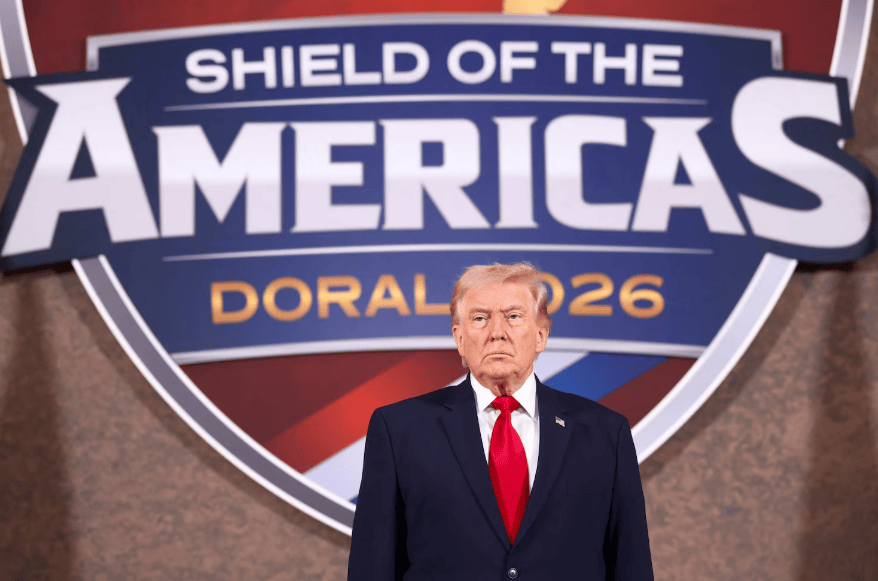
Six months after its launch in Doral, the Shield of the Americas has become Washington’s main security framework in the Western Hemisphere. It brings together a dozen aligned governments against cartels and “narco-terrorists”. It was built without Europe, and partly against the model of cooperation the EU has promoted in Latin America for two decades.
Behind the war on drugs, the initiative pursues two other goals: militarising the response to organised crime and pushing back Chinese influence. Since July, it has also become a channel for Washington’s campaign against the International Criminal Court. For Europe, the question is how to respond without either endorsing a logic it rejects or alienating partners who badly need help against organised crime. The EU should neither oppose the Shield head-on nor ignore it. It should offer a competing and complementary model, built on the rule of law, trade agreements already in force and partners outside the coalition.
Key takeaways
- A partisan coalition. The Shield gathers governments close to Washington. Without Brazil and Mexico, it misses two of the countries that matter most in the fight against organised crime.
- A militarised approach. It treats organised crime as a war, extending the US strikes on suspected drug boats that have killed more than 200 people since September 2025.
- China is the implicit target. Most analysts read the anti-drug agenda as cover for a contest with Beijing over influence, infrastructure and critical minerals.
- The ICC is the new front. Washington is now pressing coalition members to leave the Court. Chile and Costa Rica have publicly refused, showing the limits of alignment.
- Europe has been silent, but not powerless. Its best cards are rule-of-law security cooperation, the EU–Mercosur and EU–Chile agreements, critical raw materials partnerships and dialogue with countries outside the Shield.
A coalition built in Doral
The Shield grew out of a military track. On 5 March, War Secretary Pete Hegseth gathered defence officials from 17 countries to launch the Americas Counter Cartel Coalition. Two days later, at Trump National Doral, Donald Trump signed a proclamation creating the Shield of the Americas, with the coalition as its military arm. Kristi Noem, until then Homeland Security Secretary, was named special envoy for the initiative.
The proclamation provides for intelligence sharing, coordinated operations to locate and dismantle criminal networks, and US military support to partner forces. It also targets the influence of “foreign malign actors”. The commitments remain vague: there is no funding mechanism, no public rules of engagement and no clear institutional structure.
The founding summit brought together the United States and 11 countries: Argentina, Bolivia, Costa Rica, the Dominican Republic, Ecuador, El Salvador, Guyana, Honduras, Panama, Paraguay, and Trinidad and Tobago. Chile’s president-elect, José Antonio Kast, attended as an observer. The absences mattered as much as the members. Brazil, Mexico and Gustavo Petro’s Colombia were not there, and it is unclear whether they were invited. Chatham House and PISM saw this as the initiative’s core design flaw: a hemispheric military alliance cannot meet its stated goals without them.
The map has started to shift. Abelardo de la Espriella, Colombia’s president since 7 August, asked for US help against narco-trafficking, and on 12 August Hegseth announced that Colombia had become the 19th member of the counter-cartel coalition. Brazil, Mexico and Uruguay remain outside.
More than a war on drugs
An ideological coalition. The Shield brings together right-wing governments or those close to the Trump administration, from Javier Milei and Nayib Bukele to Daniel Noboa and Rodrigo Paz. This makes short-term coordination easier but weakens the initiative over time: a single change of government can unravel it, as happened to other regional bodies now reduced to empty shells. Chatham House called it a “Trumpista-only” alliance.
The militarisation of counternarcotics. The Shield generalises a Bukele-style approach, treating organised crime as a military threat rather than a matter for police and courts. It directly extends the US strikes on suspected drug boats in the Caribbean and the Pacific. According to the Washington Office on Latin America, these strikes had killed 221 people in 63 publicised operations by 24 July.
China as the implicit target. From Chatham House to The Globalist, most analyses conclude that the war on drugs is partly a cover story and that the deeper contest is with Beijing. The Shield fits an updated reading of the Monroe Doctrine: the Western Hemisphere as an exclusive US sphere, including for investment in infrastructure and strategic minerals.
The judicial front. On 13 July, Secretary of State Marco Rubio vowed to dismantle the ICC “brick by brick”. On 12 August, in Panama, Hegseth went further and urged every member of the counter-cartel coalition to leave the Court, which he accused of threatening their sovereignty. Most Shield governments are parties to the Rome Statute, and the Court could in principle look into joint operations against cartels.
Chile, a watchful observer
Chile shows how hard the balancing act is for Latin American governments. Kast attended Doral as an observer a few days before taking office, and his government has kept that status since, describing the Shield as consistent with its own security agenda without formally joining it. When Washington turned to the ICC, Santiago drew a line: on 14 August, Foreign Minister Francisco Pérez Mackenna became the first Latin American official to rule out leaving the Court publicly. Costa Rica followed a week later.
The economic stakes explain much of this caution. China took about 36% of Chilean exports in 2025, twice the share of the United States. Aligning with the Shield’s anti-China goals would carry a high price. Chile is also a key partner for Europe. The EU–Chile Interim Trade Agreement has been in force since 1 February 2025, with a dedicated chapter on energy and raw materials, and Chile supplied about 63% of the EU’s lithium imports over 2019–2022. If Santiago moves closer to the Shield, the EU will need to make sure any investment or minerals clauses do not restrict its access.
Europe’s silence, and its red lines
To our knowledge, neither the EU nor any member state has commented officially on the Shield of the Americas. The silence reflects unease: criticising an anti-drug initiative backed by Latin American partners would go down badly, but endorsing it would validate a logic Europe rejects. European positions must therefore be read in its reactions to related issues.
The first was the boat strikes. In November 2025, the United Kingdom suspended part of its intelligence sharing with Washington on suspected vessels, for fear of complicity in potentially unlawful lethal operations, and Dutch intelligence services also scaled back cooperation. Both countries, like France, have territories in the Caribbean. The second was Venezuela. After US forces captured Nicolás Maduro in January, High Representative Kaja Kallas issued a statement backed by 26 member states, all but Hungary, calling for restraint and respect for international law without condemning the operation. Spain went furthest, signing with Brazil, Chile, Colombia, Mexico and Uruguay a communiqué that rejected unilateral military operations.
Spain has paid a price for this stance. In March, Trump threatened to cut trade with Madrid after it refused the use of the Rota and Morón bases against Iran, and the Commission expressed its solidarity. Europe’s most present country in Latin America is also the one most at odds with Washington. Finally, EU member states remain firmly committed to the Rome Statute and have rejected US attacks on the Court. The campaign against the ICC therefore strikes at one of the strongest points of convergence between Europe and Latin America.
Five levers for Europe
Security built on the rule of law
The EU already has instruments, but they lack visibility. EL PAcCTO 2.0, a €58.8 million programme, supports police and judicial cooperation against organised crime and now covers the Caribbean. The EU–LAC Alliance for Citizen Security, launched at the Santa Marta summit in November 2025, and the EU–CELAC mechanism on drugs complete the toolbox. To matter alongside the Shield, Europe should focus on what the Shield does not offer: following the money and recovering criminal assets, fighting port corruption, judicial cooperation and links between Europol and Ameripol.
The port corridor deserves particular attention. More than 70% of the cocaine entering Europe passes through Antwerp and Rotterdam. Seizures in Antwerp fell to about 55 tonnes in 2025 while they are rising upstream, in Latin American ports. The security of the transatlantic supply chain is a direct European interest, and a natural field for joint work.
Pragmatism with Shield members
The EU should not frame joining the Shield as an exclusive choice. Argentina, Ecuador and Paraguay need help against organised crime. Europe’s interest is to remain a partner for all, members or not, and to show that its cooperation is compatible with the Shield. It should also set clear limits: no European intelligence used for extrajudicial strikes, following the British and Dutch example.
The economy first
This is probably Europe’s strongest lever. Washington is building a security framework; Europe already has trade agreements in force. The EU–Mercosur interim agreement has applied provisionally since 1 May 2026 with Argentina, Brazil, Paraguay and Uruguay. The EU–Chile agreement has been in force since February 2025. Global Gateway partnerships cover lithium, copper and green hydrogen. If the Shield expands into screening foreign investment in critical minerals, the EU must make clear that it is a diversification partner, not a risk, and make sure that any screening mechanism does not target European investors.
Partners outside the Shield
Brazil, Mexico and Uruguay remain open to multilateral approaches. The EU can deepen a security dialogue with them that serves as an alternative model, without turning it into a counter-bloc. Colombia’s swing shows how quickly the map can change: a country that suspended intelligence sharing with Washington in 2025 is now part of its counter-cartel coalition.
International law, without lecturing
Latin America’s attachment to the Rome Statute is common ground with Europe, including among Shield governments, as Chile and Costa Rica have just shown. The EU can quietly support countries that resist pressure on the ICC. It should avoid moralising, which would only feed the sovereignty narrative of Washington and its allies.
France has a particular role to play. It is a Caribbean power in its own right, through French Guiana and the Antilles, and already cooperates with Washington against drug trafficking. It can follow the British and Dutch lead by attaching conditions to intelligence sharing, and use its economic presence in South America, notably in lithium, to promote a partnership model based on diversification. Its reservations about the EU–Mercosur agreement, however, limit its credibility on that front.
What to watch
- The Shield’s expansion. After Colombia, Peru’s position and the debate in Uruguay will show whether the coalition can grow beyond its original circle.
- A founding text. Any document with economic clauses on investment screening, minerals or digital infrastructure would directly affect European interests.
- Chile’s status. Whether Santiago keeps its observer position, and how Congress would oversee any change.
- The ICC campaign. Whether other coalition members follow Chile and Costa Rica, or announce withdrawals.
- The UN General Assembly in September, which Washington could use to give the initiative more visibility, and Brazil’s October election, decisive for both the EU–Mercosur agreement and the Shield.
Neither opposition nor indifference
The question for Europe is not whether the Shield will last, but whether Latin American governments will come to see security cooperation with the United States and economic partnership with Europe as compatible or competing. Opposing the Shield would push its members further towards Washington; ignoring it would leave the definition of hemispheric security to others.
The EU’s best response is to make its own offer harder to ignore: concrete cooperation against organised crime that respects the rule of law, trade and investment agreements that already deliver, and a steady defence of international law. Europe does not need to be part of the Shield to matter in Latin America. It needs to show that it brings what the Shield does not.
Sources
- Chatham House, “Trump’s ‘Shield of the Americas’ coalition is destined to fail”, 9 March 2026; PISM, “The United States Hosts the ‘Shield of the Americas’ Summit”, 10 March 2026.
- GMU Center for Security Policy Studies, “The Shield of the Americas and the Militarization of Counternarcotics”, 9 April 2026; The Globalist, “The Shield of the Americas: When Rebranding Replaces Strategy”, 29 July 2026.
- Carnegie Endowment, “What’s Driving the Trump Administration’s Push to Dismantle the ICC?”, July 2026; JusticeInfo, “The mixed results of the anti-ICC US campaign in Latin America”, August 2026.
- AP, on Hegseth’s remarks in Panama and Colombia’s request for US cooperation, 12 August 2026; Latin Times, on the WOLA report of 24 July 2026.
- CNN Chile / EFE, on Chile’s observer status in the Shield of the Americas; Datasur, “Chile – Destinos de Exportaciones 2025”.
- NBC News, on the UK’s suspension of intelligence sharing, November 2025; Curaçao Chronicle, on Dutch intelligence cooperation, 24 November 2025.
- Euronews, “EU calls for respect of international law as Trump remains vague on Venezuelan transition plan”, 4 January 2026; Europa Press, on the Commission’s solidarity with Spain, 4 March 2026.
- European Commission, EU–Chile Interim Trade Agreement; EU–Mercosur Agreement provisional application, 23 March 2026; EL PAcCTO 2.0; EEAS, “EU and Latin America & the Caribbean working together for citizens’ security”.
- Belga, on Europol estimates of cocaine flows through Antwerp and Rotterdam; VRT NWS, “55 tonnes of cocaine seized at the port of Antwerp in 2025”, 21 January 2026.


