
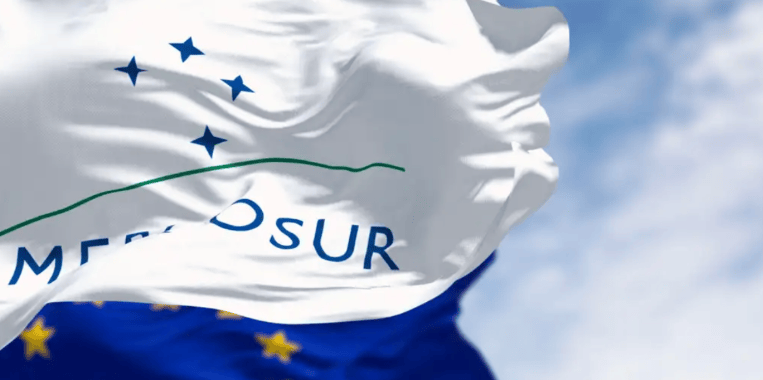
On 1 May 2026, after a quarter of a century of negotiations, the trade pillar of the agreement between the European Union and Mercosur began to apply provisionally. It is the largest tariff-reduction deal the EU has ever concluded, linking two blocs of more than 700 million people.
Most commentary has focused on who wins and who loses: European carmakers and cheese producers on one side, South American beef and soy exporters on the other. That debate matters, but it misses the main point. The agreement was concluded not because its economics suddenly improved, but because the geopolitical cost of not concluding it became too high. Its success will be measured less by trade volumes than by whether it becomes the foundation of a genuine strategic partnership between Europe and South America.
Key takeaways
- The trade deal is live; the partnership is not. Only the interim trade agreement applies. The broader partnership agreement awaits a Court of Justice opinion and ratification by all 27 member states.
- Geopolitics closed the deal. US tariffs and China’s rise as Mercosur’s leading trade partner made further delay more costly than agreement.
- Critical raw materials are the strategic core. The question is whether Europe will support processing in South America, not only extraction.
- Standards are the main fault line. Sanitary rules, the EU Deforestation Regulation and the rebalancing mechanism will decide whether the relationship deepens or turns adversarial.
- Chile completes the picture. With the EU–Chile agreement in force since 2025, Europe now has preferential access to most of South America’s economy.
Two instruments, two speeds
The road to 1 May was short at the end and long before it. A political agreement was reached in December 2024. The Council authorised signature on 9 January 2026 by qualified majority, with Austria, France, Hungary, Ireland and Poland voting against and Belgium abstaining. The texts were signed in Asunción on 17 January, and the four Mercosur parliaments (Argentina, Brazil, Paraguay and Uruguay) ratified them in February and March.
What now applies is the Interim Trade Agreement, which covers trade and investment and falls within the EU’s exclusive competence. The EU–Mercosur Partnership Agreement, which adds political dialogue and cooperation, is a mixed agreement that every member state must ratify. That process is likely to take years: a realistic horizon is the end of the decade.
The legal track is also uncertain. On 21 January the European Parliament voted, by 334 to 324, to ask the Court of Justice of the EU whether the agreement is compatible with the Treaties, in particular the decision to split it into two instruments and the so-called rebalancing mechanism. Parliament’s consent is suspended until the Court rules, which could take up to two years. The referral does not prevent provisional application, but it means the deal will operate for some time under a legal question mark.
What changes for trade
The agreement liberalises around 91% of tariff lines on the EU side and 92% on the Mercosur side, with long transition periods. Mercosur’s high tariffs on European industrial goods will be phased out gradually: up to 35% on cars (over 15 years, 18 for electric vehicles), 18% on chemicals and 14% on pharmaceuticals. The European Commission estimates that European exporters will save more than €4 billion a year in duties once the phase-in is complete, and that EU exports to Mercosur could grow by up to 39%.
European firms also gain access to public procurement in Mercosur countries, and 344 European geographical indications are protected. On the agricultural side, access to the EU market for the most sensitive products is capped by quotas: beef, for instance, is limited to 99,000 tonnes a year at a 7.5% tariff, about 1.5% of EU production. A safeguard regulation adopted on 5 March 2026 allows the EU to suspend preferences quickly if imports of sensitive products surge or prices fall sharply.
Why the stakes are strategic
A hedge against an unpredictable United States
Both blocs have been on the receiving end of US tariff policy. In July 2025 Washington imposed a 50% tariff on a broad range of Brazilian goods, a measure Brasília regarded as political, while Europe faced its own escalation. For both sides, the agreement offers something increasingly scarce: a large market whose access is governed by negotiated, predictable rules rather than unilateral decisions.
Remaining relevant as China rises
China overtook the EU as Mercosur’s largest trading partner in 2023. In 2025, trade between Brazil and China reached a record US$171 billion, and China absorbed 28.7% of Brazilian exports, against 10.8% for the United States. The agreement will not reverse this trend, and it should not try to. For Mercosur, its value lies in diversification. For Europe, it is a way to stay a central economic partner in a region where its relative weight has been eroding for two decades.
Critical raw materials and economic security
The agreement fits into Europe’s economic-security agenda as much as its trade policy. The EU sources about 82% of its niobium from Mercosur, and the region holds significant reserves of lithium, copper and rare earths, all of which the Critical Raw Materials Act identifies as essential to the energy and digital transitions. The agreement reduces or removes export taxes on most raw materials from Argentina, Paraguay and Uruguay, while Brazil retains some room to tax certain exports.
The real test, however, is not access but the kind of partnership Europe offers. South American governments, Brazil’s in particular, want to export processed minerals and industrial products rather than ore. China competes by combining finance, infrastructure and purchase commitments. If Europe offers only regulatory standards and market access, it will lose that competition. If it combines long-term offtake agreements, financing through Global Gateway, whose Latin American investment agenda was announced in 2023 at around €45 billion, and technology transfer for local processing, the agreement can anchor a durable industrial relationship.
An asymmetry to address
The economic models point to a lopsided outcome: European exports are expected to grow faster than Mercosur’s, largely because Mercosur’s tariffs on European goods are much higher than the EU’s on South American commodities. Unless Europe pairs the agreement with investment and cooperation, it risks being perceived in Mercosur as a market-opening exercise that mainly benefits European exporters. That perception would weaken the political support the deal needs to survive successive elections.
Chile and the regional picture
Chile is not a party to the agreement, but it matters to the bigger picture. Its own interim trade agreement with the EU has been in force since February 2025. Taken together, the two frameworks give Europe preferential access to most of South America’s economy, and open the way to regional value chains, for instance in mining and logistics projects linking Chile and Argentina, that European investors can now plan across borders.
What could derail it
- The Court of Justice. A negative or qualified opinion would not end provisional application automatically, but it would weaken the agreement’s legitimacy in Europe and could force changes.
- Standards and sanitary rules. The most disruptive disputes may arise outside the agreement itself, from EU rules on food safety or animal health that Mercosur exporters see as protectionist.
- The EU Deforestation Regulation. From 30 December 2026 it will apply to large and medium-sized operators, covering beef, soy, coffee and wood. Mercosur governments view it, along with the carbon border adjustment mechanism, as a barrier adopted outside the negotiated framework.
- The rebalancing mechanism. It allows a party to seek compensation if new laws impair its trade benefits. Critics in Europe fear it could constrain environmental and health regulation.
- Political calendars. Brazil votes in October 2026 and Argentina in October 2027. Argentina also signed a trade and investment agreement with the United States in February 2026, and any move to align its rules with Washington’s could erode European support.
From market access to partnership
The tariff schedules will now run on autopilot. The cooperation agenda will not. Three priorities stand out. First, joint working groups on sanitary rules, traceability and deforestation compliance, so that disputes are anticipated rather than managed after the fact. Second, a raw-materials investment framework that rewards processing in South America, not only extraction. Third, aligning Global Gateway and European development finance with the agreement’s priorities, in energy, minerals and infrastructure, to address the asymmetry that critics on both sides of the Atlantic are quick to point out.
The agreement gives Europe and Mercosur a framework. Whether it becomes a partnership depends on what both sides build on it in the years before the comprehensive agreement is ratified.
Sources
- Council of the EU, “EU-Mercosur agreements explained” and press release of 9 January 2026.
- European Commission, “The EU-Mercosur trade agreement”, and press release of 23 March 2026 on provisional application.
- European Parliament, press releases of January 2026 (request for a CJEU opinion) and February 2026 (agricultural safeguards).
- M. Fleischhauer Corrêa da Costa and P. Regazzoni, “EU–Mercosur Trade Agreement: From Negotiations to Application”, Intereconomics, 61(3), 2026.
- China-Brazil Business Council (CEBC), “Comércio Brasil-China atinge recorde de US$171 bilhões em 2025”, January 2026.
- NPR, “Trump sets 50% tariff rate for Brazil”, 9 July 2025.
- European Commission, Access2Markets, implementation of the EU Deforestation Regulation; Global Gateway Investment Agenda with Latin America and the Caribbean, July 2023.


